
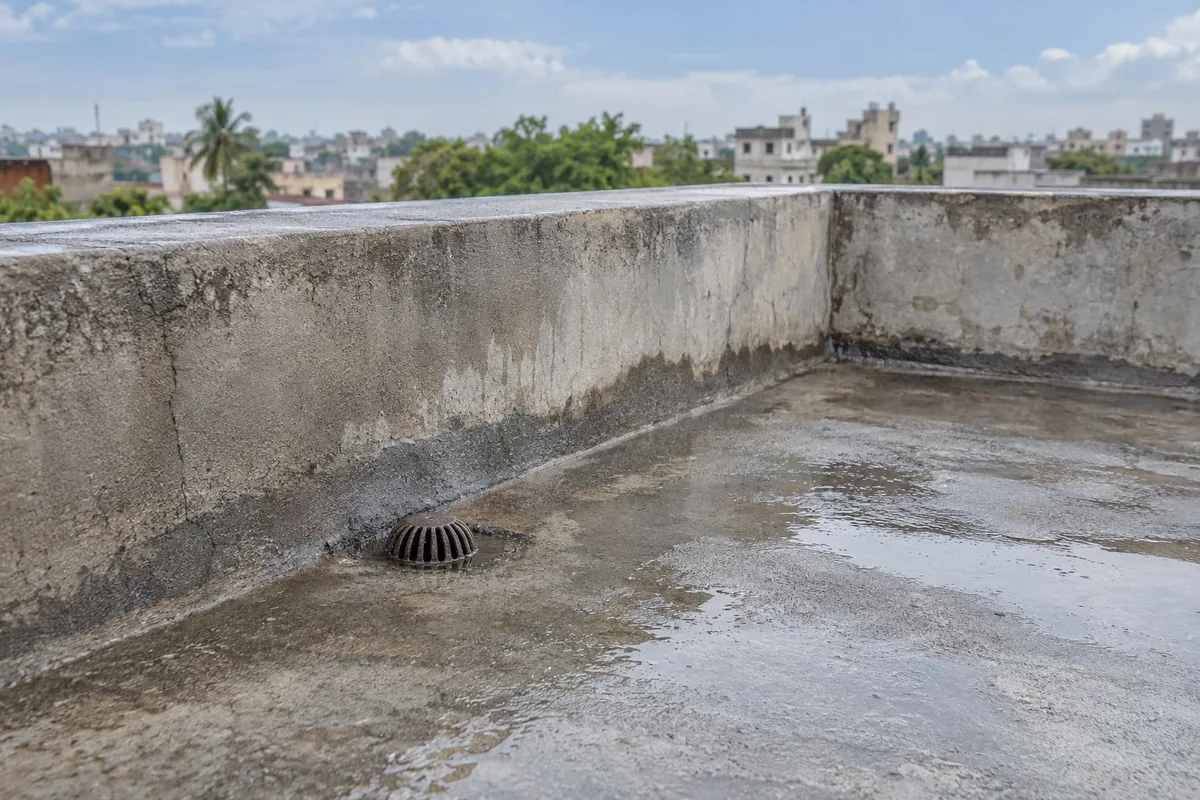
A ceiling stain shows where water has become visible, not necessarily where it entered. Buying a coating before investigating can leave the actual problem untouched: a blocked outlet, defective junction, damaged pipe connection or unsuitable surface.
For an RCC roof in Pakistan, ask three questions: where can water enter, how should it drain, and what condition is the supporting construction in? Use the findings to agree a repair suited to the roof’s loading, exposure and use.
Start with a safe inspection and a useful record
Do not climb onto a wet or unsafe roof to investigate a leak. Keep clear of damaged electrical fittings, unstable ceiling finishes and unprotected edges. Water near electrical equipment, visibly sagging construction or falling material needs prompt professional attention.
From a safe location, record:
- Where dampness first appears and whether it spreads.
- Whether it follows rain, water-tank use, plumbing activity or another event.
- How long after the event the stain becomes visible.
- Any recent work involving solar supports, pipes, tanks or rooftop equipment.
- Previous repair locations and the products or layers used, if known.
If dampness appears along a wall or beside a bathroom, compare the evidence with damp-wall diagnosis and bathroom waterproofing details before assuming the roof is responsible.
Use repeat photographs and a simple roof plan to locate defects and compare changes.
Check the roof as a complete assembly
Drainage and low areas
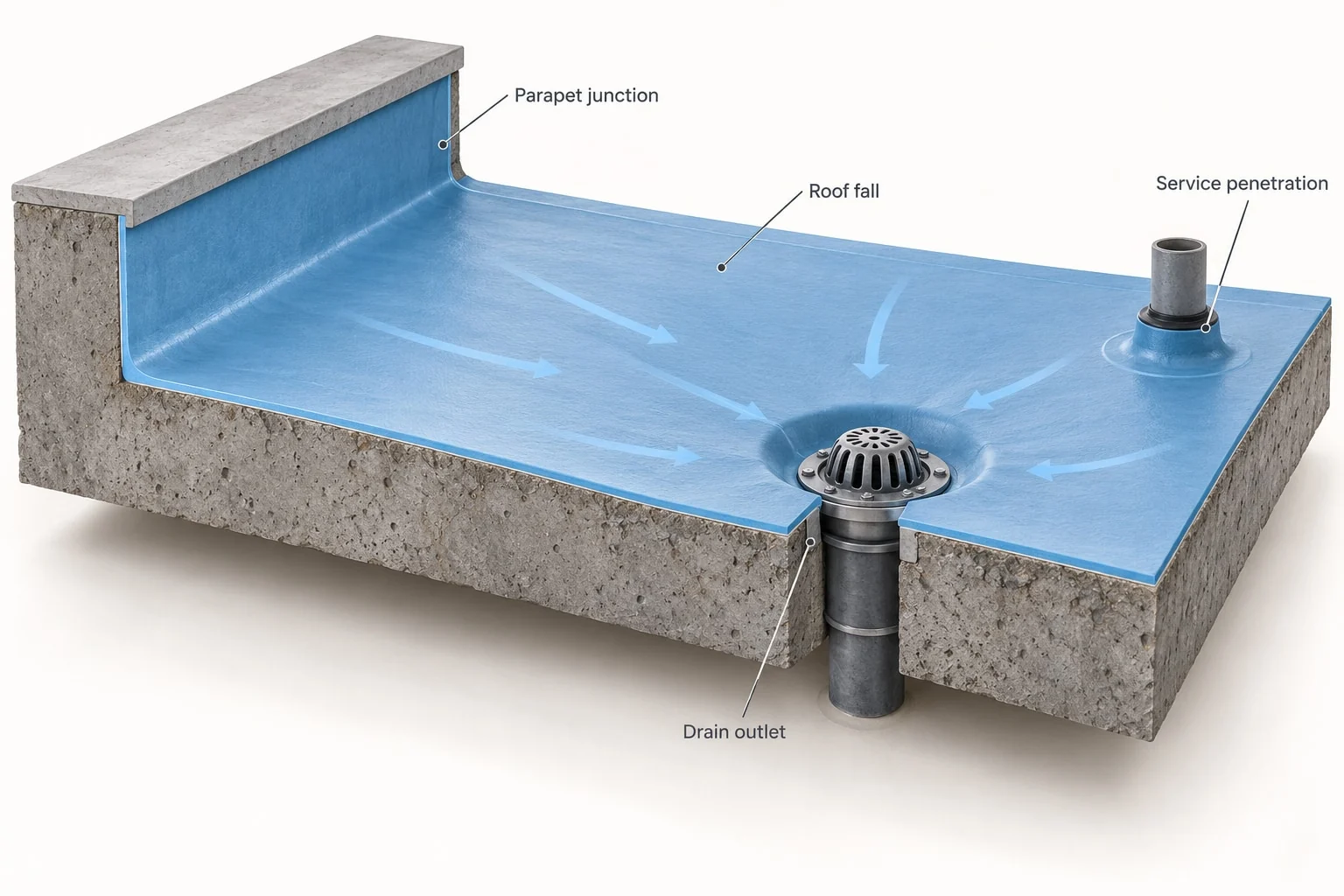
Locate the outlets and the intended route water takes to reach them. Look for debris, blocked strainers, low areas and obstructions introduced by later work. Ask whether the roof's falls and outlet arrangement are adequate, rather than assuming every puddle can be solved with another coating.
Pakistan manufacturer Ressichem's roof-repair guidance also begins with source identification, slope assessment and screed condition. Its named products and mixing instructions belong to that particular system; they are not recipes for other materials. Ressichem roof and balcony guidance
Parapets and changes of direction
Follow the boundary where the horizontal roof meets a parapet or another wall. Ask how the waterproofing continues through that junction and how its upper edge is protected. Check the condition of coping, flashings and adjoining finishes where present.
A quotation should identify these details explicitly. “Waterproof the roof area” is too vague if the work excludes the very junction suspected of leaking.
Pipes and equipment supports
List pipes, drains, supports, ducts and fixings, including later additions. Agree who handles each interface: dividing the pipe and surrounding waterproofing between trades without a connection detail leaves a gap in responsibility. NHBC's flat-roof guidance highlights service penetrations, outlets, junctions and protection from subsequent work as important inspection points. Its UK guidance is a reference for these principles, not a Pakistani code requirement. NHBC flat-roof quality guidance
Cracks and existing layers
Record cracks without assuming their cause or movement from appearance alone. The assessor may need to distinguish a surface defect from movement involving the supporting construction.
Also establish what the new material would actually bond to. Is it sound concrete, screed, an old membrane, paint, tile or several poorly documented layers? Loose or unsuitable material cannot become a dependable base simply because a waterproof coating is added above it. The inspection should define what can remain and what requires removal or repair.
Choose the material role after the defect is understood
Roof systems can include repair material, falls or levelling layers, waterproofing, insulation, protection and a finished surface. One product name does not describe the complete build-up.
SEED's waterproofing application overview separates coatings, crystalline treatments, admixtures and joint details. Use those distinctions to frame the specification, rather than treating all products in the category as substitutes.
A surface coating, repair mortar, movement-joint detail and lightweight roof mortar serve different functions. None automatically replaces the others or defines the complete roof assembly.
The exact product remains important. The manufacturer's English VELOSIT WP 124 sheet, edition 4525, distinguishes flexible and semi-flexible formulations and lists specific roof-related applications. That does not establish that either option is suitable for every exposed roof, traffic condition or existing coating. Confirm the supplied components and complete system before using the WP 124 product reference in a specification.
Similarly, the TENSYL CC101 overview describes a coating role, while IZONIL QUATRO is a lightweight mortar reference. Their different functions should remain clear in both the quotation and the construction detail.
Ask for a repair scope that can be checked
Ask the proposal to explain the suspected cause, evidence and investigation limits, then state:
- Which existing materials will be retained or removed.
- Which drainage, substrate and junction defects will be corrected.
- The selected products, components and matching technical documents.
- The details at outlets, parapets, penetrations and movement joints.
- The installation conditions and protection required during the work.
- How the completed waterproofing will be checked before it is covered.
- Who will protect it during later activities and maintain accessible details.
Verification must suit the roof and selected system. Do not block outlets and fill a roof with water as an improvised test: the additional load, water escape routes and risks to occupied rooms need assessment. The test method, readiness criteria and acceptance record should be agreed beforehand.
EPA's moisture-control guidance treats design, construction checks and maintenance as connected responsibilities. That is a useful basis for asking for a complete repair process rather than a product-only quotation. EPA moisture-control guidance
Roof repair checklist
Before authorising work, confirm:
- A roof plan and photographs linked to the reported leak.
- An assessment of outlets, falls and water accumulation.
- A record of cracks, penetrations and existing layers.
- A clear distinction between local repair and wider replacement.
- Details for all relevant interfaces, including later equipment additions.
- Matched product documents and a complete application specification.
- A safe inspection or testing plan with acceptance criteria.
- Maintenance instructions and a record of concealed work.
Frequently asked questions
Can I waterproof only the patch above the ceiling stain?
A local repair may be appropriate when the defect and its boundaries have been established. The stain's position alone is not enough to justify that scope. Ask how the proposed repair reconnects with the surrounding waterproofing.
Is the most flexible coating always the best choice?
No single property determines suitability. Substrate compatibility, exposure, traffic, finish and junction design also matter. A material's flexibility does not automatically accommodate every moving joint.
What should I send when asking for technical help?
Send the roof location and use, photographs, approximate area, existing layers, timing of leakage and recent alterations. SEED's technical support page provides a route for discussing the actual condition and relevant material references.
References
Sources checked on 22 October 2026. International guidance is used for general building principles, not as a declaration of Pakistani regulatory compliance.
- EPA Moisture Control Guidance for Building Design, Construction and Maintenance.
- Ressichem Rectification of Leaked Roof or Balcony Using Water Guard 491, a manufacturer-specific system reference.
- NHBC Best Practice Guide: Multi-storey and High-rise, Section 10, flat-roof guidance.
- VELOSIT WP 124 English technical data sheet, edition 4525.