
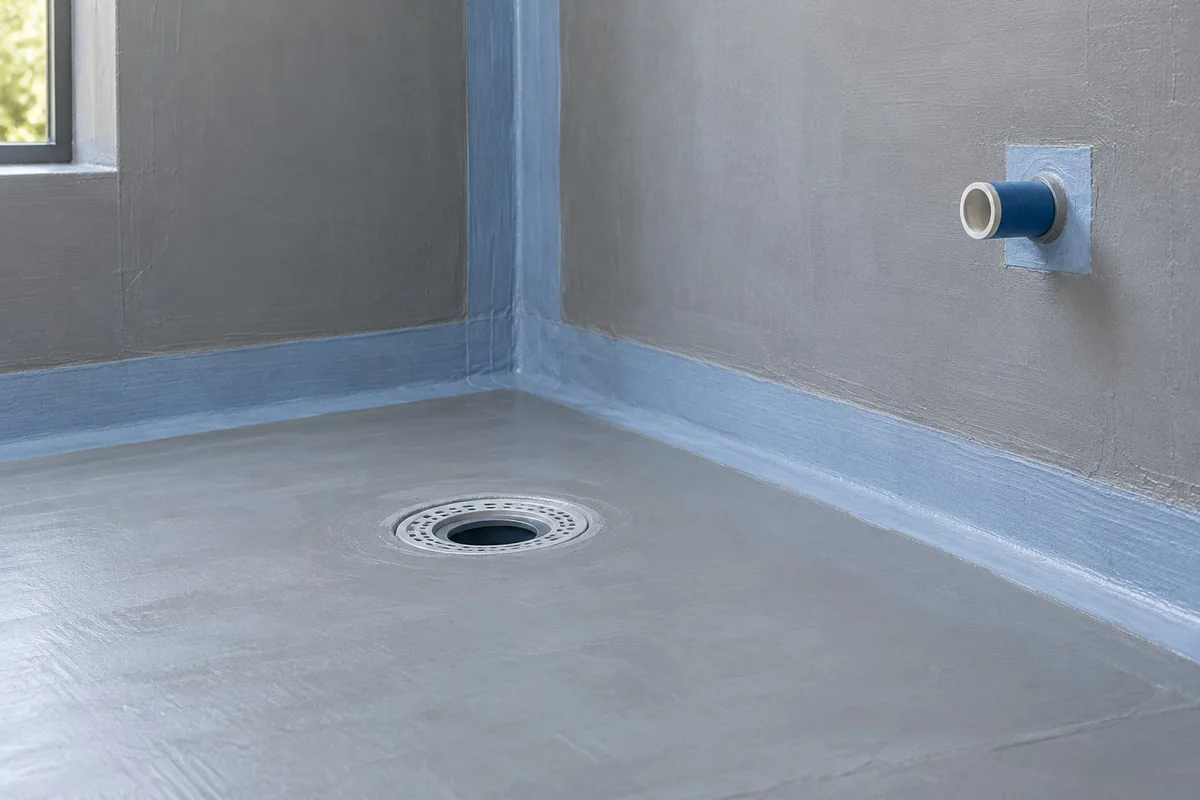
Before tiling, bathroom waterproofing should form a continuous assembly through floors, wet-area walls, drains, corners and service penetrations. Coating the open floor does not establish how its edges connect.
Tiles and ordinary grout joints should not be relied on as the complete waterproofing system. Schluter’s explanation of shower waterproofing membranes describes how water can pass through a tiled finish to the material beneath it. The concealed water-control layer therefore needs to work before it is covered.
For Pakistan’s concrete and masonry bathrooms, coordinate the plumber, waterproofing applicator and tiler: agree completed details and what each trade must protect.
Agree the floor build-up before choosing a coating
Draw the slab, services, screed, waterproofing, adhesive, tiles and drain, identifying the waterproofing plane.
Different assemblies place the membrane at different levels. Ressichem’s Pakistan bathroom-floor system illustrates a protected layer beneath a screed and discusses services and drainage. Bonded waterproofing assemblies can instead place the membrane directly below the tile adhesive. These are different build-ups, with different connection requirements; their layers should not be casually combined.
The drawing should locate water routes, the drain connection, falls, services and finished doorway levels.
For the distinction between different floor materials, see self-levelling compound, screed and wearing-surface selection. A material selected to smooth a floor should not automatically be specified to create a bathroom drainage slope.
Start with a surface that the selected system accepts
Record cracks, voids, loose material, contamination and previous coatings. Agree the chosen system’s preparation, repairs and substrate condition. Do not conceal unresolved defects or assume transitions between concrete, masonry, board and render need identical preparation.
SEED’s waterproofing overview provides context for material roles. The TENSYL CC 101 Cementitious Waterproof Coating and VELOSIT WP 124 pages are separate product-selection starting points. Request current, locally applicable technical documents and a compatible assembly; a common waterproofing category does not make products interchangeable.
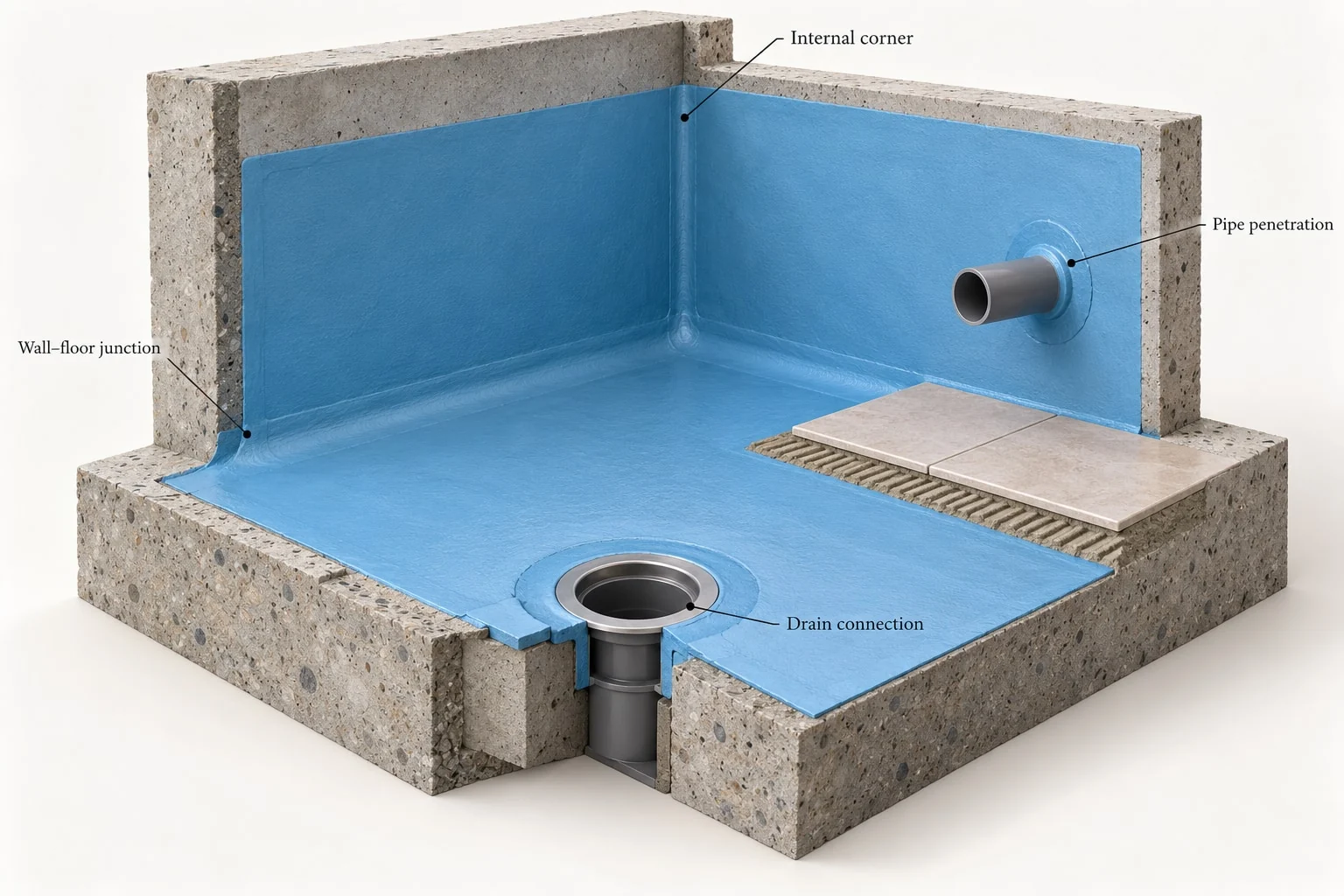
Five junctions to resolve before tiling
1. The drain connection
The concealed connection, not just the grate, must suit the waterproofing arrangement.
Schluter’s comparison of tiled shower systems distinguishes traditional liner-and-clamping-drain arrangements from bonded membranes connected to an integrated bonding flange. This illustrates why the plumber and waterproofing applicator should agree the drain type before either completes their work.
Check the collar, flange or approved adaptor and its level against the waterproofing plane. Unspecified sealant around an ordinary opening does not demonstrate a compatible system.
2. Wall-to-floor corners
The floor membrane must continue into the specified wall waterproofing without an unplanned break at the corner. Identify the wall extent from the wet-area design, rather than applying an arbitrary upstand everywhere.
Inspect internal and external corners before covering. Confirm how components connect across changes of plane, using compatible bonding materials and methods where tape is specified.
The VELOSIT DB 830 technical data sheet, edition 0624, identifies wall-to-slab junctions and substrate transitions among its applications. Its use remains subject to defined substrate, movement and water-direction limits.
3. Pipe entries and mixer openings
List supplies, waste pipes and mixer openings. Decorative covers do not establish waterproof connections: specify a manufacturer-supported collar, sleeve or other detail suited to each opening and substrate. DB 830’s data sheet includes a sleeve arrangement for pipe penetrations, demonstrating that a penetration is treated as a specific detail rather than simply brushed around.
The SEED DB 830 product page can support that component discussion. It does not approve every possible penetration geometry.
4. The doorway and shower threshold
Check membrane termination and water containment at the wet-area edge, threshold or doorway.
A flush shower entrance needs coordinated floor levels, falls and containment. Removing a step changes the detail; it does not remove the need to manage escaping water. Schlüter’s walk-in shower planning guidance highlights drainage and doorway waterproofing as planning considerations.
Agree how door frames, screen channels and other fixings avoid compromising the waterproofing.
5. Movement joints
Ordinary tile-grout lines and designed movement joints serve different purposes. The Tile Council of North America’s movement-joint guidance explains that movement accommodation is needed because the tile and supporting materials can expand and contract differently; joint placement depends on site conditions.
Have the designer or system supplier identify the required joints and specify how both waterproofing and tile finish accommodate them. A flexible coating or tape does not justify filling a designed movement joint solid. Equally, visible sealant at the tile face does not by itself prove that the concealed waterproofing detail is correct.
Inspect and test before covering the work
Record “ready for tiles” acceptance against the selected system: continuity, repairs, junctions, penetrations and application records. For liquid-applied products, coat count alone is insufficient; agree how manufacturer application and coverage requirements will be checked.
A water test can help reveal leakage before tiling. Schluter’s water-test guidance describes it as a quality-control step before tile installation and ties testing to the assembly’s curing requirements.
Use the project’s approved test procedure. Agree the area, safe water level, duration, drain-isolation method, inspection locations and acceptance criteria. Do not copy another manufacturer’s test timing or flood an occupied bathroom without an assessed plan. Consider the consequences for rooms and electrical installations below.
Record results and repairs, then repeat required verification after correction. The result applies to the tested conditions; it neither replaces plumbing tests nor guarantees against later damage.
A before-tiling handover checklist
- Drawing: The waterproofing plane, wet-area extent and complete layer sequence are agreed.
- Plumbing: Required service tests are recorded and unresolved leaks are closed out.
- Substrate: Preparation, repairs and required surface conditions are accepted.
- Drainage: Levels and falls match the designed assembly and drain connection.
- Junctions: Corners, thresholds, pipe entries and movement joints are complete.
- Materials: Product identity, component compatibility and application records are available.
- Verification: Inspection and specified testing are complete, with defects resolved.
- Protection: Responsibility for protecting the accepted work is assigned to the next trade.
Photograph details before covering. Agree access, protection and damage reporting; verify repairs to later punctures or alterations before concealing them.
Frequently asked questions
Are two coats enough for bathroom waterproofing?
A coat count alone cannot answer that. The exact system determines application requirements, coverage, reinforcement, substrate preparation and curing. Junctions and penetrations must also be completed correctly.
Can new grout fix leakage into the room below?
Do not assume it will. Investigate the plumbing, drain connections and waterproofing. For dampness appearing on adjacent walls, see diagnosing seepage before putty and paint.
How long should the bathroom dry before testing or tiling?
Use the selected products’ current instructions and site conditions. There is no single drying or curing interval that applies to every membrane, adhesive and repair material.
Sources and scope
Reviewed 22 October 2026. Overseas proprietary systems explain design principles, not a substitute specification for SEED products or Pakistani code requirements. Final selection and details require project-specific technical review.
- Schluter: What Are Waterproofing Membranes?.
- Ressichem: Waterproofing System for Bathroom Floors.
- Schluter: Tiled Shower Waterproofing Systems.
- VELOSIT DB 830 technical data sheet, edition 0624.
- Schlüter: Planning Walk-in Showers.
- Tile Council of North America: Movement-Joint Placement.
- Schluter: Water Testing a Shower System.