
Integral crystalline waterproofing introduces reactive chemistry into fresh concrete to reduce water permeability within the hardened material. It can be valuable for basements, tanks and other water-excluding or water-retaining structures. A complete waterproofing design must still address the concrete mix, cracks and joints. VELOSIT CA 112 technical sheet
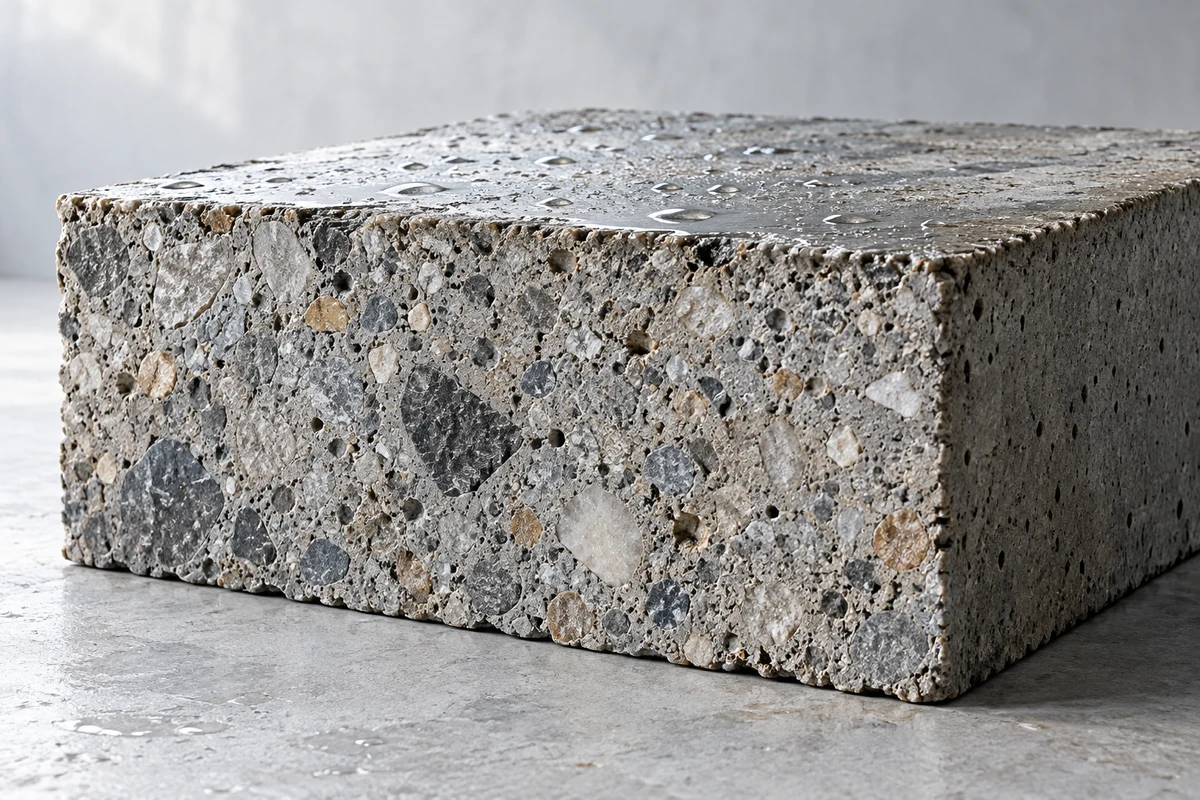
Concrete → cement paste
What happens within the pore space
The mechanism belongs at the pore scale. The detail below is a schematic of cement paste, separate from the aggregate visible above.
Integral admixture
Reactive ingredients are introduced with the fresh concrete mix.
Surface treatment
Reactive ingredients are supplied at the prepared concrete face.
Magnified cement-paste pore detail · not to scale
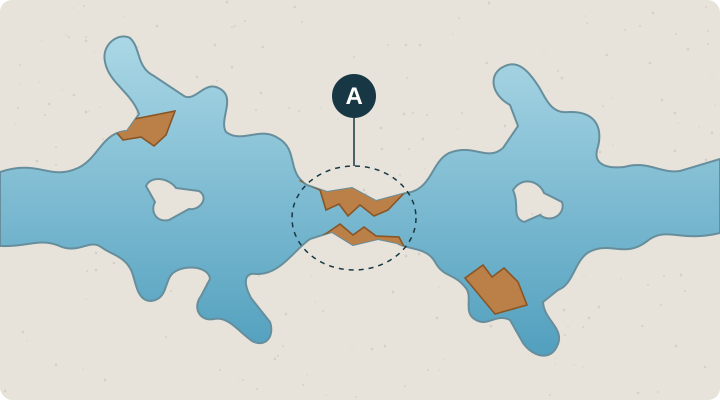
A · Partial narrowingDeposits occupy part of a connected pore throat. The illustration does not show a sealed barrier.
Cracks and construction joints still need their own design and detailing.
How the technology developed
Crystalline waterproofing has a history extending well beyond today's admixtures. Vandex's own history records that Danish chemist Lauritz Jensen patented a capillary-active concrete waterproofing method in 1943 and founded Vandex in 1946. Kryton documents the introduction of its Krystol Internal Membrane admixture in 1980. These are manufacturer-reported milestones, rather than independent proof of a single inventor for the whole technology. Vandex history, Kryton's KIM development account
The important development for construction was the availability of both surface treatments and products incorporated during mixing. By 2013, the American Concrete Institute's educational bulletin discussed hydrophilic crystalline chemicals among permeability-reducing admixtures for hydrostatic conditions. ACI E4-12, section 5.6
How moisture activates crystalline waterproofing
Concrete contains connected pores through which water can travel. Crystalline chemistry reacts with water and cementitious constituents to produce deposits that obstruct these pathways. Incoming moisture can reactivate suitable crystalline admixtures, helping to seal small cracks. The process is a chemical response inside concrete, rather than a liquid-repellent film painted over it. ACI E4-12
Activation takes time. For example, VELOSIT states that CW 111 requires several days of water contact to develop its full crystalline effect. An early handling or curing milestone should not be presented as proof that full waterproofing has already developed. CW 111 technical sheet
Integral admixture or surface-applied treatment?
- Integral admixture: VELOSIT CA 112 is added to fresh concrete at the batching plant or through an approved truck or site-mixing procedure. Selection therefore belongs in the concrete specification before placement. Manufacturer sheet
- Surface-applied crystalline treatment: VELOSIT CW 111 is applied to prepared concrete by brush or spray; it also has a specified dry-shake route for fresh slabs. Its chemistry acts within the concrete, but it is not the same product or dosing process as an integral admixture. Manufacturer sheet
This distinction matters when comparing quotations: coating an existing wall and treating a new concrete mix are different scopes of work.
Where it can help
Appropriately selected crystalline systems can reduce water penetration in underground concrete, tanks and tunnels. An integral approach places the water-resisting treatment within the concrete rather than relying solely on an external barrier. For an existing structure, an approved surface-applied product may provide a practical treatment route from an accessible face. Suitability depends on the selected system and exposure. ACI E4-12, CW 111 technical sheet
What it cannot replace
Self-sealing claims have limits. VELOSIT reports static-crack capacities up to 0.5 mm for CA 112 and 0.4 mm for CW 111 under its stated conditions. These figures are not permission to accept moving joints, structural defects or uncontrolled cracking. Laboratory performance is not a blanket site guarantee. CA 112, CW 111
Before specification, check four essentials:
- Concrete quality: Confirm the mix, dosage basis, compatibility and mixing route; undertake appropriate trials.
- Placement and curing: Compact correctly and follow the specified curing regime. An admixture does not repair poor workmanship.
- Joints and defects: Detail construction joints separately. For existing concrete, treat active leaks, leaking cracks and honeycombing before the selected coating.
- Exposure evidence: For water under pressure, request relevant pressure-test evidence, not only a water-absorption result. Check drinking-water suitability separately where applicable. CA 112 requirements, CW 111 preparation, ACI test guidance
For a project in Pakistan, explore SEED's waterproofing systems, consult the technical-document library, or discuss your concrete and water-exposure conditions. Match the supplied product, current technical and safety sheets, and project design before application.