
Polycarboxylate ether, usually shortened to PCE, is a family of polymers used in concrete water-reducing admixtures. Its practical attraction is the ability to disperse cement particles while giving formulators control over initial flow and workability retention. For a concrete producer, that can create useful options: easier placement without extra water, lower water demand, or a trial-qualified redesign of the mix.
The advantage is not identical for every product or cement. Buyers should compare the concrete each admixture produces, under the conditions in which it will actually be delivered and placed.

At the grain surface
Attached backbone, outward side chains
The backbone adsorbs at the cement surface. Flexible side chains extend into solution and help resist close approach.

Steric hindrance and electrostatic interactions contribute to dispersion. Their balance depends on the polymer and cement system.
Clustered arrangement

Dispersed under mixing
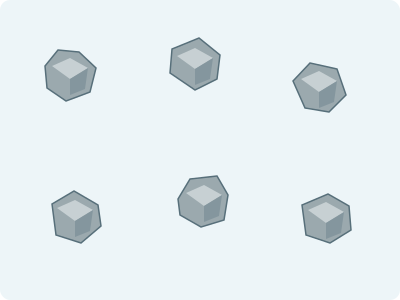
Same six grains. Same solution field. Only their positions change; the schematic does not add water or represent a measured mix.
What happens inside cement paste
When cement contacts water, particles can gather into clusters called flocs. Some water becomes held within those clusters rather than contributing effectively to flow. A dispersing admixture helps separate the particles.
A typical PCE has a backbone carrying groups that adsorb onto cement surfaces, with flexible side chains extending into the surrounding pore solution. These chains hinder close approach between particles. This is called steric hindrance: a spatial barrier that helps resist renewed clustering. Electrostatic interactions also contribute. Sika's March 2025 technical description of PCE explains this distinction from conventional sulfonated naphthalene and melamine systems. It supports the general mechanism, not a performance claim for another manufacturer's product. Sika technical description
Dispersion does not remove the need for mixing, suitable aggregate grading or adequate paste volume. A chemical cannot compensate for every weakness in a concrete mix.
How the main admixture families differ
Lignosulfonate-based plasticizers have a long-established role in concrete water reduction and workability improvement. Their performance depends on formulation and modification. A 2021 experimental study comparing lignosulfonate-derived dispersants with naphthalene and PCE references illustrates that polymer chemistry changes dispersing behaviour; the family name alone is not a full specification. Magina and colleagues, Materials, 2021
Sulfonated naphthalene formaldehyde, or SNF, and sulfonated melamine formaldehyde, or SMF, are conventional superplasticizer chemistries. Their dispersing action is commonly associated with electrostatic repulsion. PCE adds a strongly influential side-chain steric mechanism. SNF and SMF should therefore not be dismissed as ordinary low-range plasticizers: they also serve high-range water-reduction applications. Sika's comparison of the mechanisms
PCE's particular strength is molecular design flexibility. Manufacturers can adjust polymer architecture and combine formulations to favour water reduction, initial workability or retention. Those priorities can involve trade-offs rather than all improving together. Sika's PCE technology guide
Where PCE can provide practical benefits
The first opportunity is obtaining the required placing consistency with less mixing water. Alternatively, an admixture can improve consistency while the water and cementitious contents remain unchanged. Lower water demand can also support a redesigned mix with reduced cement content. These are alternative design routes, not three guaranteed benefits obtained simply by adding a chemical. ACI guidance on water-reducing admixtures
For ready-mix delivery, a retention-oriented formulation may help maintain usable workability through transport and waiting. For precast work, initial dispersion and the required strength-development schedule may carry greater weight. PCE design allows these needs to be addressed differently. A product optimised for one should not be assumed to suit the other. Sika's PCE technology guide
For pumping or congested reinforcement, adequate flow is useful only if the mix remains stable and can be properly placed. High-range water reducers support flowing and high-performance concretes, but some can also be associated with rapid slump loss. Initial slump is therefore not sufficient evidence of suitability. NRMCA Chemical Admixtures for Concrete
Why two PCE products may behave differently
Fang and colleagues tested two PCE structures in two cement systems in their 2023 study. They observed differences in adsorption, initial dispersion and hydration response. The practical lesson is that neither the word “PCE” nor a single headline water-reduction result establishes equivalence between formulations. The experimental polymers in that paper are not TENSYL products. Fang and colleagues, Materials, 2023, corrected 2024
Compatibility also includes the aggregate fines. Research on montmorillonite shows that this clay can take up PCE through surface adsorption and entry of side chains into its layers. That can reduce the polymer available to disperse cement. Investigate material changes instead of assuming a disappointing result always means the dose is too low. Cement and Concrete Research, 2022
What a fair comparison should establish
Use the same defined project requirements and traceable materials. Record:
- Required consistency initially and at the relevant delivery and placement times.
- Water content, binder identity, aggregate moisture and actual concrete temperature.
- Product identity, dosage basis, mixing sequence and any other admixtures.
- Air content, stability, setting behaviour and practical placing observations.
- Required strength ages and specified durability performance.
Agree acceptance criteria before testing. Compare the cost per cubic metre of concrete that meets those criteria, rather than the price per kilogram of chemical. NRMCA recommends assessing admixture compatibility, construction needs, specifications and economic benefit together. NRMCA guidance
For temperature and delivery planning, read SEED's hot-weather concreting guide. When the binder changes, the LC3 admixture-trial guide explains the qualification questions.
SEED's TENSYL PCE Plasticiser product reference provides a starting point for selection. Request the matched technical and safety documents and share your materials, placing window and acceptance requirements through technical support.