

When a concrete load arrives stiffer than expected, stop the informal water adjustment and check the approved mix, delivery record and acceptance requirements. A useful response may involve an authorized adjustment, a revised placement plan or rejection of a nonconforming load. The decision belongs within the agreed quality procedure, not to whoever is holding the hose.
For exposed slabs and long urban deliveries in Pakistan, agree the materials, transport window and placing plan before dispatch.
Hot weather involves more than air temperature
High concrete temperature, low humidity, wind and direct sun can matter alongside the forecast air temperature. NRMCA's Hot Weather Concreting guidance explains that adverse combinations accelerate moisture loss and hydration, creating problems with workability, setting and early-age protection.
Record conditions relevant to the pour. Use the specified concrete-temperature and environmental limits, and agree the response when conditions move outside the approved plan. A familiar summer routine is not evidence that today's mix and delivery arrangement will perform as required.
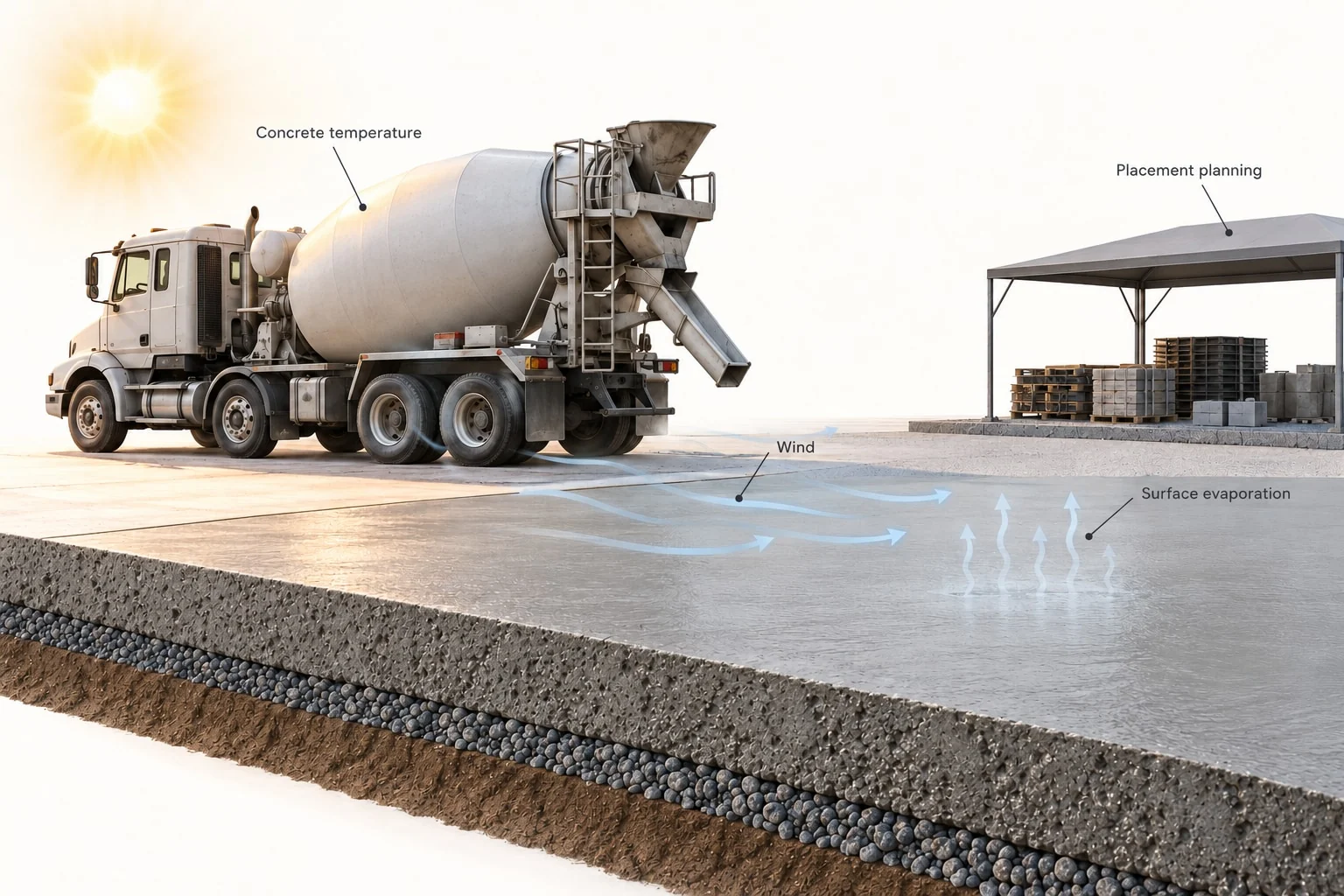
Distinguish three problems before choosing a solution
Slump loss during transport and placing
Workability can change between batching, arrival, pumping and final placement. The project needs sufficient usable workability at the relevant stage, not merely a satisfactory measurement immediately after mixing.
Setting and finishing time
The time available for consolidation and finishing is a related but separate question. A change intended to delay setting does not establish that the concrete will retain the required placing consistency throughout delivery.
Surface moisture loss
A load can remain workable while its exposed surface loses moisture rapidly. A mix adjustment does not replace surface protection, suitable finishing practice or curing. ACI's hot-weather overview identifies accelerated slump loss, increased water demand and plastic-shrinkage risk among the concerns that planning must address.
What water reducers and retarders actually tell you
A water-reducing admixture is selected to change the relationship between water demand and workability. A retarding admixture is selected for its effect on setting. Some products combine these functions, and particular formulations may be designed for workability retention.
The distinction appears in the public scope of ASTM C494/C494M-19, which separately identifies water-reducing, retarding and combined categories. The specification also recommends testing with the actual project materials and conditions where practicable. Its published classification is useful background; the contract must identify the standard and edition that govern the job.
“PCE” identifies a chemical family, not a guaranteed retention period or dosage. SEED's TENSYL PCE Plasticiser guide accordingly calls for formulation-specific instructions and trials with the actual binder, aggregates and other admixtures. It does not establish a universal water reduction, strength increase or retention time.
Do not blend admixtures or change the addition sequence on the assumption that two individually familiar products will behave predictably together.
Agree the delivery-to-placement window before the pour
At the pre-pour meeting, draw a simple timeline: batching, journey, gate access, testing, pump queue, placing, consolidation and finishing. Then identify where time is most likely to be lost.
Agree who can slow dispatch, who communicates a pump stoppage and which person has authority over acceptance and adjustments. Check that the laboratory, placing crew and producer use the same mix reference. Flag constituent changes even when the ordered strength class stays the same.
Ask the producer how trials will represent the expected temperature and delay. Establish what observations and tests are required over time, including consistency, stability, setting and specified hardened properties. Keep the trial record with the approved mix, rather than treating it as a separate sales document.
Use a documented arrival decision
When the truck reaches site, first verify the load identity and delivery information. Apply the specified sampling and testing procedure, and compare the results with the project's acceptance criteria.
NRMCA's Jobsite Addition of Water guidance makes an important distinction: controlled water addition can be permitted where the approved limits are respected. Excess water beyond the design allowance can reduce strength and durability and increase cracking risk. Admixture adjustment also requires a planned, qualified procedure.
That means both blanket instructions, “always add a little water” and “water can never be added,” miss the necessary controls. Before any authorized adjustment, establish the available allowance, known batch quantity, applicable limits and required remixing and retesting. Record what was added and who authorized it. Do not use an improvised litres-per-slump rule as permission to change the mix.
If the load fails the agreed criteria or its condition cannot be established, escalate through the quality plan before placing it. A pump waiting on site does not change the acceptance requirements.
Protect the placement operation as well as the mix
Match the pour size to the crew and equipment. Complete site preparations and inspections before dispatch, and plan for interruptions.
The hot-weather plan may include producer-controlled cooling measures, adjusted scheduling, shading or wind protection, and specified surface-moisture controls. Select these for the actual conditions and approved method. Water used for surface protection must not become uncontrolled mixing or finishing water.
Curing materials and supervision should be ready before the first placement. Do not postpone this discussion until finishing is complete. The companion article on curing compounds and water curing explains why the intended later finish also matters when choosing the curing method.
A practical pre-pour checklist
Confirm the following with the producer and site quality team:
- Approved mix reference and current constituent identities.
- Required consistency at the specified acceptance and placement stages.
- Expected temperature, journey, waiting time and placing rate.
- Trial evidence for the proposed admixture and actual binder combination.
- Authority, limits, records and testing for any site adjustment.
- Dispatch coordination, interruption response and nonconformance procedure.
- Consolidation, finishing, surface protection and curing arrangements.
Frequently asked questions
Does low slump mean the concrete has already set?
Not by itself. A slump result measures consistency under a defined test; it does not provide a complete diagnosis of the load's history or suitability. Review the other required information and tests before deciding what action is permitted.
Can a retarder replace a slump-retaining admixture?
Do not assume so. Define both the placing-workability requirement and the setting requirement, then qualify the selected formulation with the actual mix. A combined product may serve both purposes, but its name alone does not prove performance.
What temperature is too hot to pour concrete?
Use the governing project specification and approved hot-weather procedure. ACI's temperature-limit FAQ illustrates that named specifications set concrete-temperature limits and require qualification for higher-temperature mixtures. It does not create one universal Pakistan-wide weather cutoff or cover every mass-concrete situation.
Where should an admixture enquiry start?
Send the binder and aggregate details, other admixtures, placing method, workability requirement and expected transport and temperature conditions. SEED's concrete-admixture application guidance and technical-document hub provide a starting point for requesting matched product information.