
Regional disruption does not mean every construction chemical is unavailable. Buyers in Pakistan should verify where the material is, its shipping route, quotation terms and whether the complete approved system will reach site before work starts.
This article reviews evidence available on 22 October 2026. It explains procurement risks rather than forecasting prices or reporting any particular supplier's stock position.
What the current evidence actually establishes
Maersk's 13 October 2026 regional market update describes continuing Middle East disruption affecting cargo flows, routing options, transit times and delivery arrangements. The carrier recommends sharing cargo-ready dates and delivery priorities early and confirming capacity. These are operational uncertainties, not a statement that all trade has stopped.
The International Maritime Organization's 28 August statement also documented unresolved navigation problems in the Strait of Hormuz and consequences for commodity supply chains. Its assessment belongs to that date; it should not be read as a live vessel-status report.
For Pakistan, the Finance Division's September 2026 economic update identifies elevated oil prices as a risk to input costs and the import bill. It also describes stronger external buffers. A balanced procurement assessment should recognize both exposure and the capacity to absorb it.
None of these sources establishes a shortage of a particular waterproofing coating, concrete admixture or flooring system at a Pakistani distributor. That requires product-level confirmation.
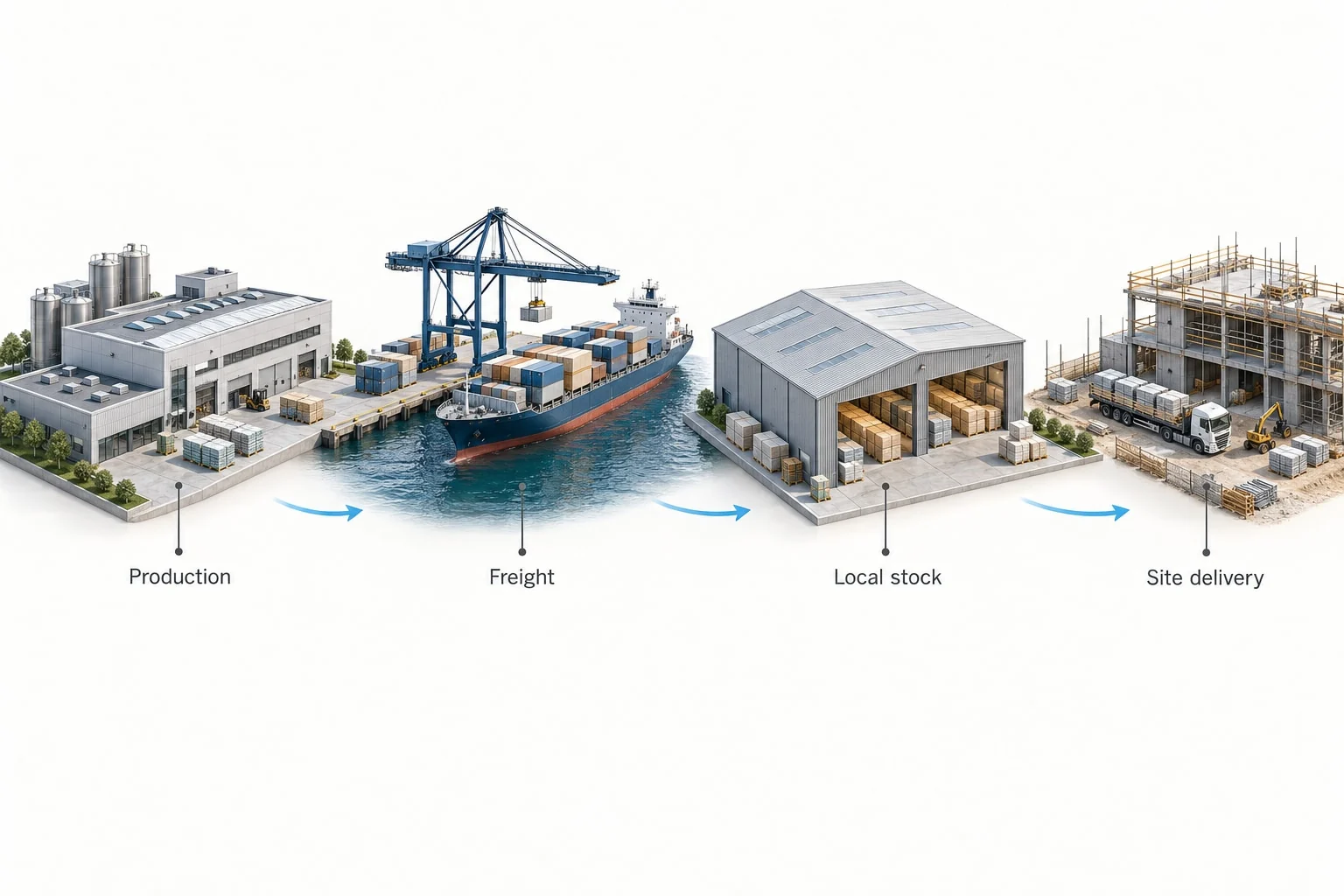
How disruption can reach a construction project
The physical route. Imported products may depend on particular ports, hubs or feeder services; local products may depend on imported ingredients or packaging. Verify the actual supply chain. Not every shipment to Pakistan passes through the Strait of Hormuz.
Shipping acceptance and capacity. The question is whether the carrier accepts the specific cargo on the proposed route and sailing. Dangerous-goods classification depends on the product and its documentation; the word “chemical” alone does not establish a transport classification. Have the supplier or forwarder confirm acceptance against the applicable safety and transport information.
Energy and upstream inputs. Some construction-chemical ingredients sit within petrochemical supply chains. The effect on a finished formulation depends on its composition, manufacturing location, contracts and existing inventory. In its 24 March 2026 AGM FAQ, Sika explained that downstream petrochemical purchases dilute and delay the connection to crude prices. It reported transport surcharges and some pricing actions while reporting no major supply-chain disruption at that point. Those were Sika's circumstances, not a current Pakistan-wide finding.
The delivered quotation. Currency conversion, freight, insurance, inland transport and commercial terms can change the landed cost independently of the factory price. Compare the full delivered scope. A lower product-only price may not be the lower cost of getting the approved material to the workface.
Separate physical stock from an expected arrival
Ask suppliers to identify which of these descriptions applies:
- Material physically held in the named local warehouse and available for allocation.
- Material already allocated to your purchase order.
- Material shipped, with a documented route and an estimated arrival.
- Material ordered from the manufacturer but not yet dispatched.
- Material available only against a future production or import order.
Confirm every required component, including flooring primers and hardeners or waterproofing joint-detail materials. List the complete application phase and identify unconfirmed items.
Make quotation assumptions visible
A useful comparison sheet records more than price per bag or kilogram. Include the exact product and grade, pack size, supplied components, quantity, taxes, delivery location and any exclusions.
Ask whether freight and insurance are included, which party handles changes to routing, and how long the offer remains valid. Record whether the delivery date is confirmed or estimated and what must happen before it becomes firm. Where a quotation uses a foreign-currency basis, identify the agreed conversion mechanism rather than assuming that today's exchange rate applies until delivery.
For imported orders, the Pakistan Single Window import guide shows that consignment, commodity, financial-instrument and document information form part of the declaration workflow. Obtain transaction-specific clearance advice from the responsible importer or customs professional. The guide is not a complete list of requirements for every chemical.
Buy a useful buffer without creating a storage problem
Before increasing an order, check the manufacturing date, remaining shelf life, packaging condition and the product's storage instructions. Establish where it will be stored, who will inspect it and how batches will be issued. Keep kits and their component identities traceable.
Size the buffer around installation sequence, replacement lead time and stoppage risk. Buy only what the project can protect and use within the manufacturer's limits.
SEED's technical-document hub distinguishes selection guides from matched technical and safety sheets. Use the current documents for the actual supplied product when checking storage and application requirements.
Qualify alternatives before they become urgent
A substitute must satisfy the original function and surrounding system, not simply share a generic description such as “epoxy” or “PCE.”
Record the original performance requirement, substrate, exposure, application sequence and receiving finish. Ask the responsible technical team to assess the proposed replacement, including interfaces with retained components. Obtain any necessary project approval before ordering or installation.
Concrete admixture changes may need fresh mix trials. A coating change may affect preparation, primer choice, timing or subsequent layers. A water-contact application may require a new document review. The SEED product guides help identify material roles; they do not establish automatic interchangeability.
A pre-order checklist for project teams
Before releasing the purchase order, confirm:
- Exact product, formulation or grade, components and total phase quantity.
- Stock location, allocation status and evidence supporting any incoming shipment.
- Route, cargo acceptance and the meaning of the stated delivery date.
- Quotation validity, currency basis, included charges and exclusions.
- Batch age, remaining shelf life and suitable storage arrangements.
- Matched technical and safety documents and required project approvals.
- An agreed response if a critical component is delayed.
Assign one person to reconcile supplier updates with the site programme.
Frequently asked questions
Does the conflict mean construction chemicals are unavailable in Pakistan?
Availability varies by product, supplier, stock and route. Obtain dated confirmation for the exact order rather than relying on headlines.
Will a rise in oil prices cause the same percentage rise in chemical prices?
No universal conversion applies. Formulation, processing, inventory, freight and commercial terms matter. Request a current, like-for-like quotation.
Should we replace an imported product with a local one?
Assess the product against the project specification and complete system. Origin alone does not establish suitability; obtain technical approval before substitution.
What should we send with a procurement enquiry?
Provide the specified product or application, quantities, site location, required installation dates, substrate and exposure, and any approval requirements. Use SEED technical support to request product-document guidance alongside commercial confirmation.