
Rock wool can form the insulating layer in an external wall system with a protective rendered finish. Success depends on selecting a complete, compatible system for the wall and its exposure. Buying insulation, mortar and mesh separately does not establish that the combination will perform as intended.
This guide covers ordinary building-envelope applications. It explains what homeowners, designers and contractors should verify before choosing a rendered mineral-wool system, without prescribing a construction detail for an unassessed building.
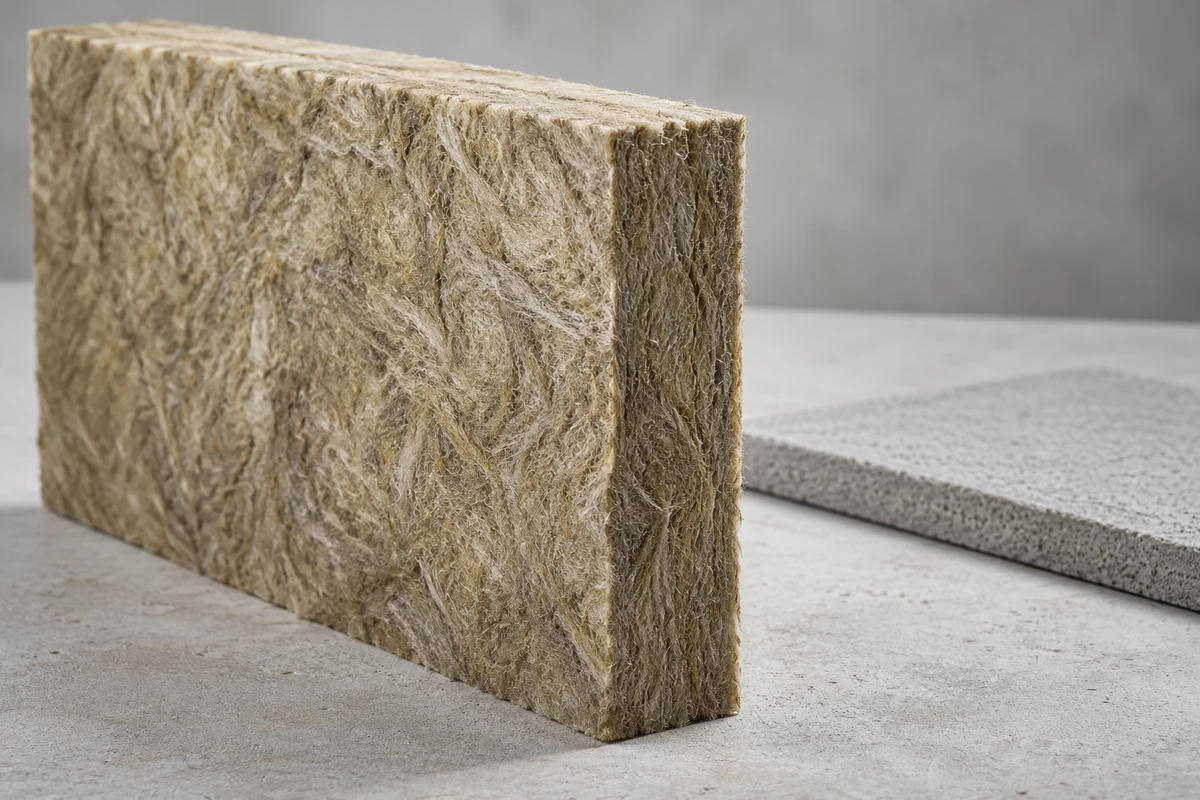
System evidence before assembly
The board is one component of the specification
Select the complete rendered insulation system. Similar-looking materials do not establish compatibility.
Specified components
Correct board, support and fixings, basecoat and mesh, finish and junction details.
Complete-system evidence
Manufacturer instructions, relevant tests, supported substrates and limits of use.
Project suitability
Actual substrate and exposure, structural attachment, water management and applicable fire requirements.
A board’s reaction-to-fire classification does not establish a completed wall’s fire-resistance duration.
A different protective layer needs separate design and evidence.These rendered-system references do not establish a generic shotcrete-over-wool assembly.
Use insulation intended for the application
Rock wool is also called stone wool, within the wider mineral-wool family. Products are made for different duties. A flexible blanket intended for a cavity should not be assumed interchangeable with a board designed to receive a rendered system.
For example, ROCKWOOL Frontrock is specifically described as a stone-wool board for mechanically attached exterior insulation and finish systems. The manufacturer directs designers and installers to follow the system supplier’s component and specification details. This is evidence that such systems exist, not a claim that this product is stocked by SEED or approved for every project in Pakistan.
Select the complete system
A rendered external insulation specification needs to identify the substrate, insulation, attachment method, reinforced base layer and finish, together with junctions and water-management details. The selected system’s instructions determine how those elements work together.
Weber’s webertherm XM literature, for example, describes specified insulation, fixings, mesh-reinforced coatings and compatible finishes. It also places limits on application conditions. Changing a board, adhesive or finish because another product looks similar requires the system supplier’s agreement and appropriate design review.
Render is not a universal shotcrete detail
A proprietary render over its specified insulation should not be treated as permission to spray ordinary shotcrete directly onto any rock-wool product. The manufacturer examples cited here do not establish that as a universally approved assembly.
If a proposal calls for a different cementitious protective layer, request a separately verified design. Its support, attachment to the supporting construction, weight, movement, compatibility and installation method need assessment. Insulation must not be assumed to carry a heavy facing without evidence. No generic thickness, reinforcement arrangement or fixing pattern can settle those questions for every wall. This is a specification safeguard, not an installation recipe.
Check attachment and moisture details
Ask how the insulation and finish are supported and how the attachment is selected for the actual substrate and exposure. A sound-looking surface does not by itself confirm that existing render or masonry can accept the proposed system.
Moisture problems also need diagnosis before insulation goes on. Knauf Insulation’s external-wall guidance cautions against concealing existing damp and highlights the importance of window sills, openings, roof edges and rainwater fittings. These are useful assessment priorities; its climate-specific statements should not replace local moisture analysis.
Water-repellent insulation is not a substitute for weather protection. Check how rain is shed and, where the selected system requires it, how incidental moisture drains and the wall dries. ROCKWOOL’s EIFS guidance describes manufacturer-specific assemblies and makes clear that installation depends on the tested system.
Ask for assembly-level evidence
A board’s reaction-to-fire classification does not, by itself, give a completed wall a fire-resistance duration. BEWI’s mineral-wool guidance directs users to the system supplier for the performance of the overall installation. Ask for the documentation relevant to the actual components, building type and proposed use, rather than a general “fireproof” description.
Before ordering, obtain the full specification, supported substrate conditions, thermal calculation, fire documentation, installation responsibilities and maintenance guidance. A sample panel can help agree appearance and workmanship, but it does not replace technical evidence.
If you need help reviewing insulation options, contact SEED with the building location, wall construction, photographs and intended finish. Ask the team to confirm the scope of support available and which project-specific technical information is needed.